
08
Apr 2024
Zheeeeeen Leeeeei
I found this fun shirt on Taobao:

I love characterplay but I found this shirt, while clever, a little whiny. So I checked the seller for other designs like this, but this was basically the only one of this kind.
02
Apr 2024Standing Escalator Etiquette in Japan
I always liked how people in Japan stood on one side of the escalators and let those in a hurry clomp on up or down the other side. It seemed courteous and efficient. At some point, years ago (maybe around 2010?), Shanghai also implemented such a system. Signs went up. I was told that Shanghai was adopting Hong Kong’s escalator etiquette. In any case, I saw it as progress.
Sadly, it didn’t last long. The system was abandoned after less than a year, as I recall. I never knew why.
On my last trip to Japan (March 2024), I discovered that Kyoto and Osaka are now discouraging the “stand on one side, walk on the other” escalator system. I was quite surprised by this.

I did a little research and discovered two things:
- There are a lot of old people in Japan taking the subway system. Having a “fast lane” on the escalators is seen as a safety risk. (Fair enough.)
- A study has been done which showed that the “fast lane” escalator system actually results in a lower throughput over the same amount of time. (The key is that only about 25% of escalator commuters use the “fast lane,” but it takes up half the escalator.)
So I guess this is a triumph of reason and science?
I still kind of miss the fast lane, though. In Japan and in Shanghai.

01
Feb 2024Sleep No More in Shanghai
Last Friday I went to a production of Sleep No More (不眠之夜) here in Shanghai. My wife bought us tickets. Although she has a pretty good record of choosing this kind of live entertainment, for some reason I was expecting something boring. Sleep No More is definitely not boring.
In this immersive theatre experience, the audience disperses and wonders through sets covering 5 floors while the cast act out various scenes across all 5 floors. There is no dialog and there is no way to see everything. You have to choose which characters to follow, where to go, and hope for a little luck. Going with friends really helps, because you can split up and compare what you witnessed. The story actually repeats as a loop, three times over three hours.
The whole thing feels like a dream, and the sound design enhances this. Plus every member of the audience is required to wear a white mask. This turned out to be really crucial, because it helps everyone to identify the characters in the story you’re trying to watch. It’s also a clever trick by which a member of the cast or the staff can easily disguise himself as an audience member, and the characters in the story do occasionally interact with the audience a little bit.

At one point, one of the female characters was doing a sexy dance in an old style telephone booth (the story is set in the 1930’s). The woman pulled in a member of the audience, then closed a curtain. Later on when she opened the curtain and left the booth, the audience member was gone. I investigated and found a secret door in the back of the booth. I was going to go in, but the staff pulled me away. Although the production encourages the audience to “be bold,” there are definitely places you’re not allowed to go.
Anyway, this was a very interesting theatre experience, the kind that really sticks with you. It’s not cheap (around $100 USD), but entirely worth the price. There’s not even any appreciable language barrier, given that the story is told without dialog. So if you’re in Shanghai and looking for an interesting cultural experience, this one is worth a try. (Not for kids. You will need to reserve tickets in advance.)
21
Nov 2023Thoughts on Yangshuo (Guangxi)
The first week of October is still China’s “National Day Golden Week” holiday, meaning that we get 7 consecutive days of vacation October 1-7. Of course, such a treat can’t come without a bit of pain… in this case, we also had to work the weekend after to “make up for” some of the days off. Truly a maddening system. A seven-day workweek following the holiday really does come close to nullifying the whole point of the holiday for many.
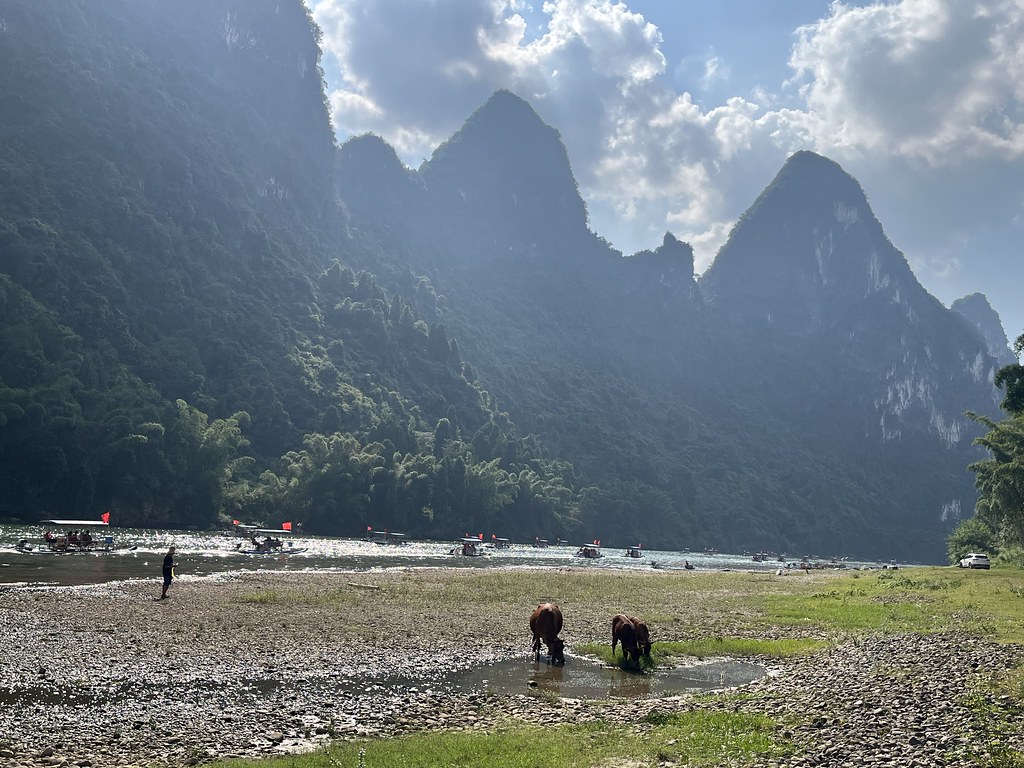
For the October holiday this year, I went on a trip with my family to Yangshuo (阳朔), a mountainous region near Guilin full of all kinds of outdoor activities. Actually, though, we didn’t really go to Yangshuo. That’s kind of the point of this post.
I first went to Yangshuo in 2003 as a teacher still living in Hangzhou. It was just becoming a popular tourist destination back then because many other choices, such as nearby Guilin, had already become way too touristy. Anyone looking for something more outdoorsy, a bit off the beaten track, had to seek out less well-known locales. At the time, Yangshuo fit the bill perfectly.
The next time I would visit Yangshuo was in 2022. My wife knew about the destination from me, and had heard good things about it. She found a local tour company that could set up family-friendly activities like swimming, hiking, caving, stand-up paddle boarding, and river trekking. What I didn’t initially know at the time was the activities planning were almost entirely not in Yangshuo, but the neighboring area. This is because in almost 20 years of development, Yangshuo had become so touristy as to be generally avoided by many travelers.
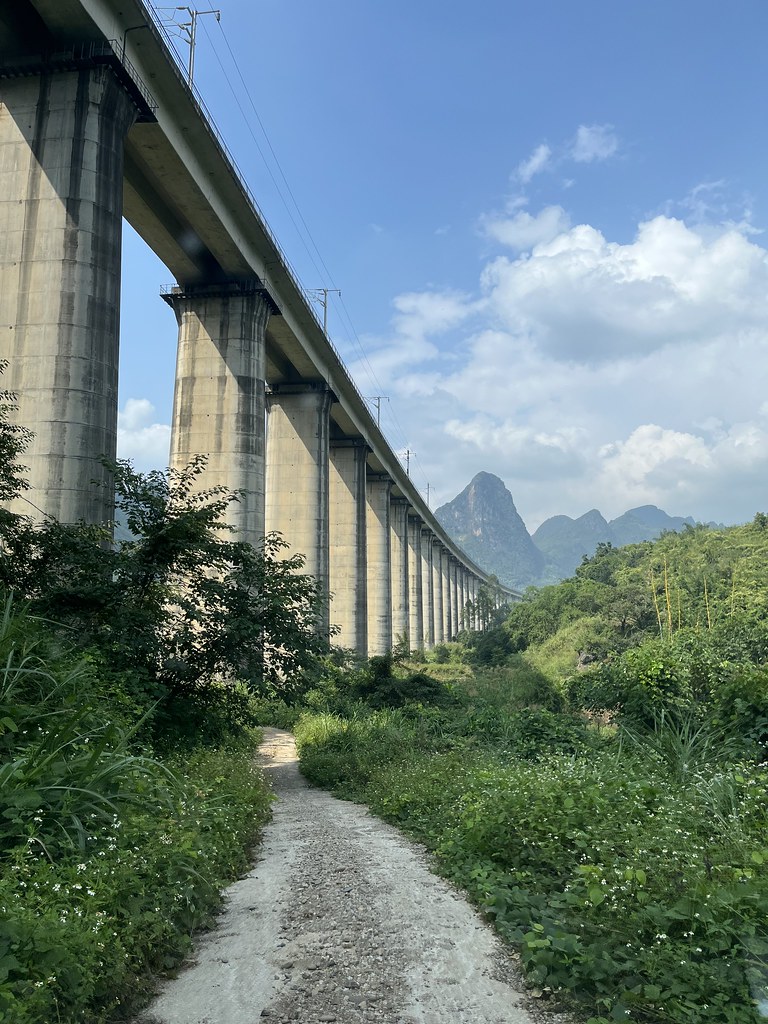
So this past trip I paid more attention. We didn’t actually go to Yangshuo at all (except maybe passing through). We spent most of our time in a county called Xingping (兴坪). It was all pretty fun, and despite the hordes of holiday tourists, we were generally able to avoid them and do our own thing.
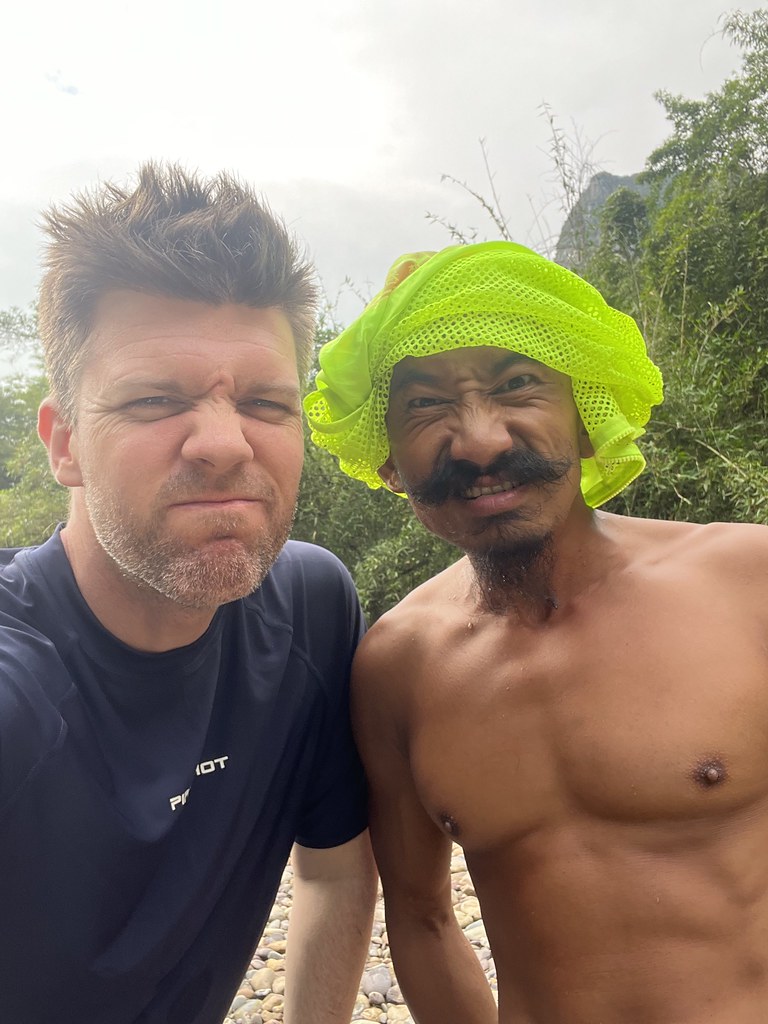
Some photos:




30
Sep 2023HACKED
Hello to my email subscribers (if you’re still there).
I’ve been hacked in a way that is only visible to my email subscribers. Spam messages are going out through WordPress.com email notifications.
I’m working on fixing it, but unfortunately this happened right when I went on vacation to Yangshuo with my family. Will try to solve it ASAP!
UPDATE: I had the problem fixed within 24 hours, but unfortunately some of you got spammy emails from Sinosplice. Sorry about that. The problem is fixed.
17
Aug 2023Chinese-like Graffiti in Atlanta
My original hometown may be Tampa, Florida, but my family relocated from there to Atlanta, Georgia in 2020. So this past July, I was finally able to take my whole China-based family to visit this new “home base” in the US. It was great to be back with family for almost a whole month after being unable to visit due to COVID for about 4 years.
I won’t say too much about the visit, other than that it was really nice. I’ve been taking a break from blogging this year, and we all had a great time.
Chinese did randomly intrude on our vacation, though, such as in this graffiti I spotted on the Atlanta Beltway.

Here’s a closeup of the part on the right:

Is this real Chinese? I’d have to say no. It does look like a “graffiti style font” of real characters in some ways, and I can recognize parts of real characters, but then they also have weird extra strokes that don’t work. There are a few “near misses,” but every single one looks off in some way.
Still, it’s fun to see this. You can tell that someone took the effort to really observe real Chinese characters and try to do their own artistic take on them.
And I do love a little characterplay!
28
May 2023Share Bikes, Stacked High
Years ago, I blogged about Mobike and how it was changing the way we commute in Shanghai. That’s old news now. COVID has come and gone (sort of). But we’re still using these shared bikes. Now there are two big names: Meituan (unlock the bikes by scanning their QR codes with WeChat) and Hello Bike (unlock the bikes by scanning their QR codes with AliPay).
These shared bikes are all over the city. Sometimes there are so many of them in one area that a sidewalk will be completely blocked. In order to redistribute the bikes in a useful way, you often see big trucks collecting the bikes from an area overflowing with them in order to send them somewhere they’re needed.
And then you might also see this:
(Videos courtesy of Issac L.)
05
Apr 2023Rate of Speech Affects Learning
I think rate of speech is one of those things that gets some attention at certain points in one’s studies (especially the beginning), but easily gets forgotten under mountains of vocabulary, tsunamis of pronunciation, and avalanches of grammar.
Here’s a You Can Learn Chinese podcast from last month where we discuss how rate of speech stays relevant at different stages of one’s studies:
- Teachers’ rate of speech (super important in the beginning)
- Dangers of not adapting to a natural rate of speech in one’s studies
- Looking for the right rate of speech for input
- Keeping goals in mind
- Using software to adjust rate of speech for listening materials
- Speaking faster vs. correct tones
- Perceived fluency gains with speaking more quickly?
03
Feb 2023Using ChatGPT to Learn Chinese
I got back from a family trip to Lijiang (Yunnan) last week. It was quite interesting being there again when my first and only trip to Lijiang happened a full 20 years ago! (Yeah, yeah… I’m old!)
I remember even then that some tourists were lamenting that Lijiang was “too commercialized.” Obviously it’s more commercialized now, but I still found it nice. One big difference is that while I used to see Naxi women in the “old town” of Lijiang wearing their traditional clothing selling food, clothing, and trinkets, I no longer do. Instead, it’s lots of tourists (mostly young women) decked out in rented Naxi garb (or even Tibetan) in order to take photos.
But anyway, I’m back in Shanghai now, and one of the reasons I’m happy to be back is that I can continue to experiment with ChatGPT every day. It’s super addictive and fun, and it also has great potential for Chinese learning. So I thought I’d share a few things I’ve discovered. I’m planning to go into more specifics in an upcoming series on the AllSet Learning blog.
What Can Chat GPT do in Chinese?
Here’s a simple rundown of some of the many things you can do with ChatGPT, starting with the obvious and getting more specific:
- Translate between English and Chinese (or whatever other languages ChatGPT can handle)
- Adding pinyin to Chinese (it often does this by default for Chinese output when the prompt is in English)
- Provide both simplified and traditional characters, or convert between the two
- Create frequency lists of Chinese characters (limited)
- Creating lists of Chinese words
- Provide Chinese characters with pinyin for an article in English which mentions Chinese words.
- Generate short paragraphs in Chinese on any topic
- Generate short paragraphs of text in both English and Chinese (parallel texts)
- Respond in Chinese to chat prompts in Chinese
Sounds pretty cool, right? OK, but hold on… it doesn’t do any of these tasks perfectly. It does most of them well, though (especially general translation).
Here’s an example of me asking for the Chinese words (with pinyin) for English output about Lijiang it had just given me:
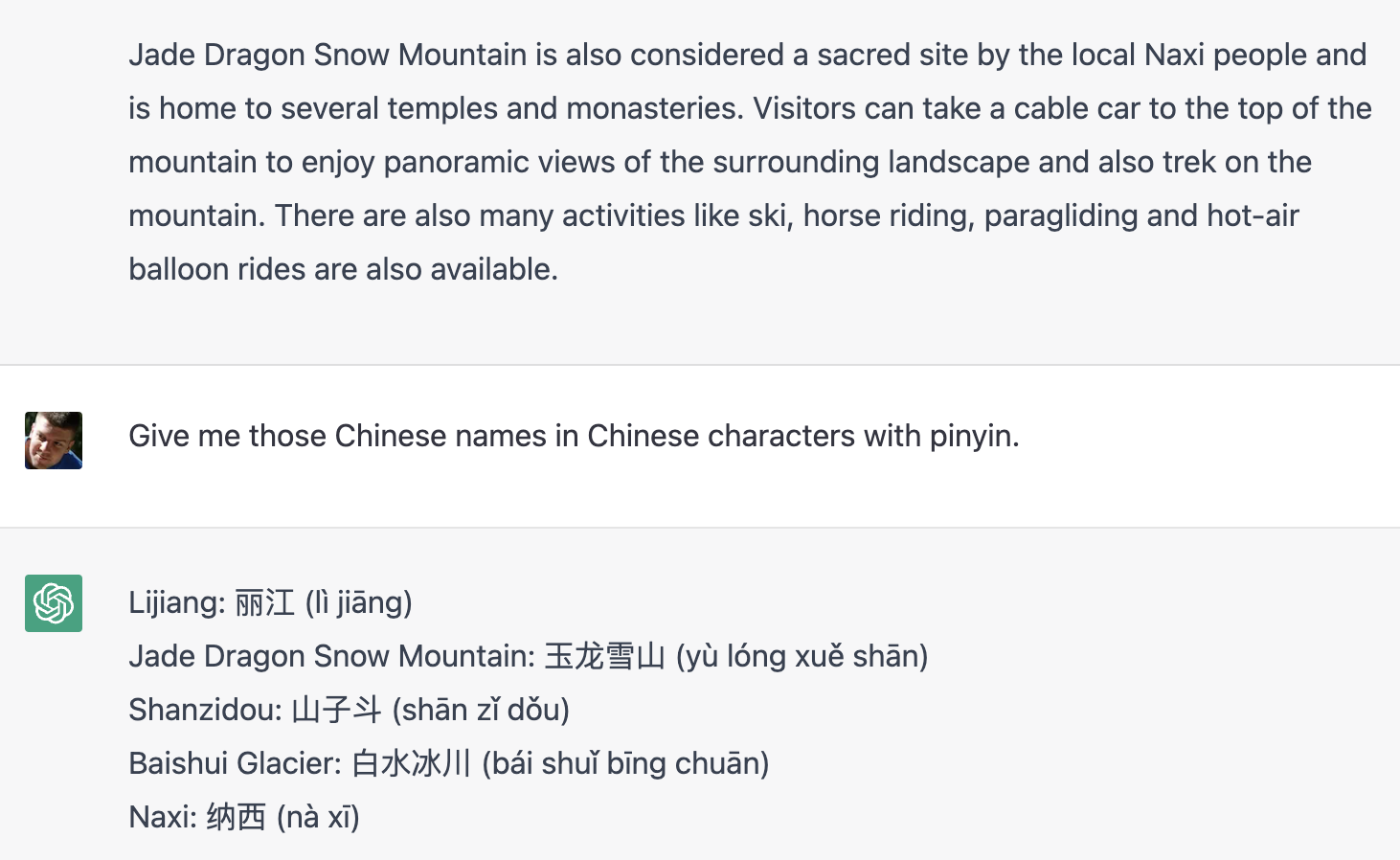
I had it generate a frequency list of Chinese characters using a custom format I wanted (with the slashes and parentheses), and also including Japanese. It did take a bit of back and forth to get the formatting right, but here’s the result:
BUT, you may be surprised to learn that ChatGPT doesn’t have access to Chinese word frequency data, so word frequency lists will be trickier.
Let’s get into more specifics about some of the other problems.
Problems with Using ChatGPT for Chinese
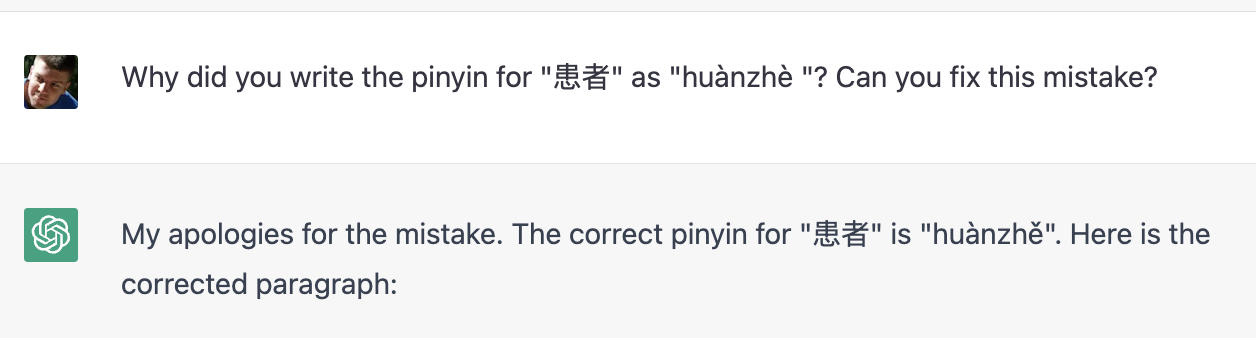
OK, first of all, the obvious: it sometimes just plain gets stuff wrong. You can correct it, and it will readily admit and correct its mistake, but you might not realize the mistake is there at all.
Here’s a simple pinyin mistake I called it out on:
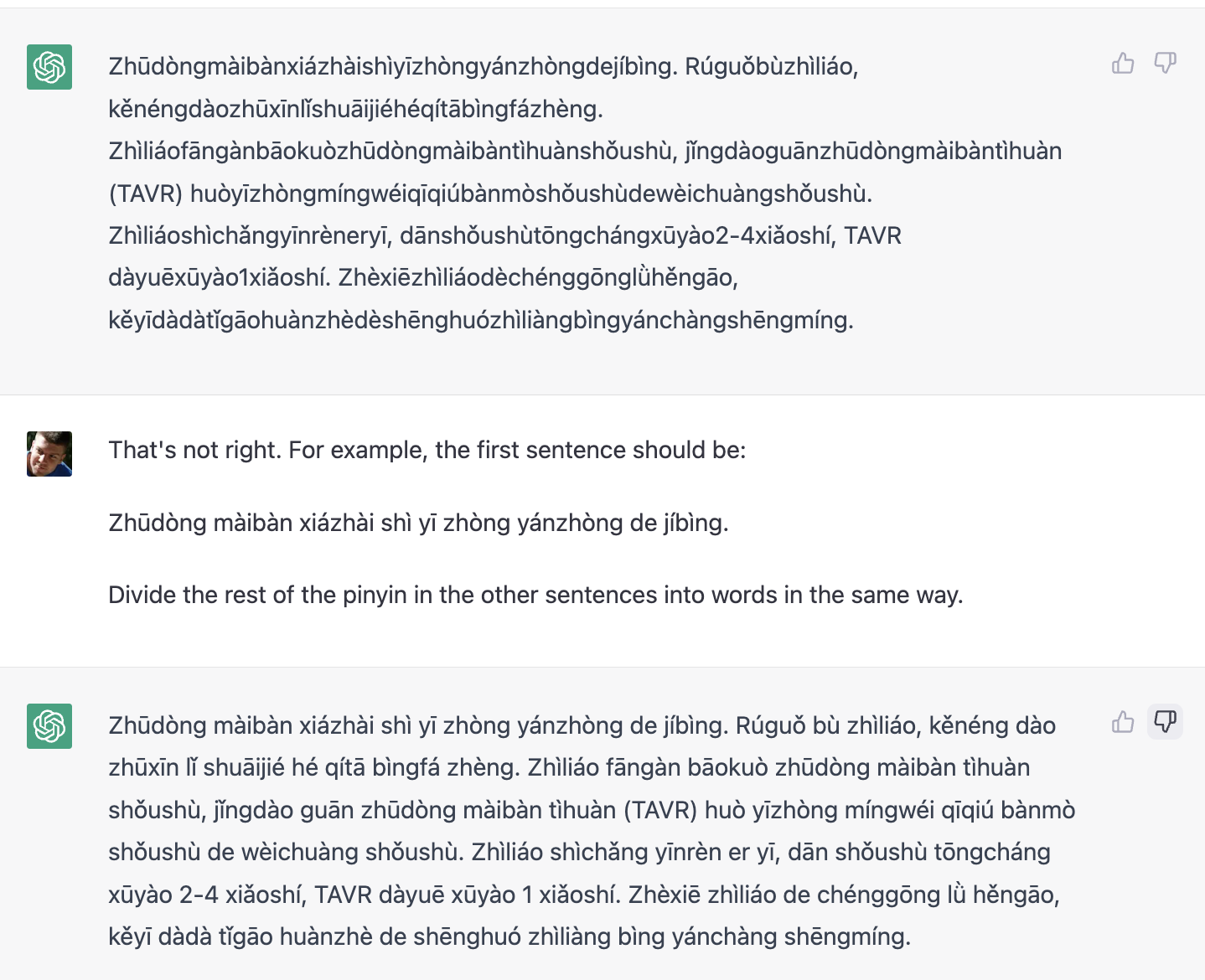
Another annoying thing is that, by default, pinyin is not grouped by words (it’s not word segmented). You can get ChatGPT to segment by words, but it’s harder than you might expect. It took me quite a few tries, and in the end, I had to manually segment the pinyin of the first sentence for it and provide that as a model. After that, ChatGPT was able to do the word segmentation (more or less) correctly.
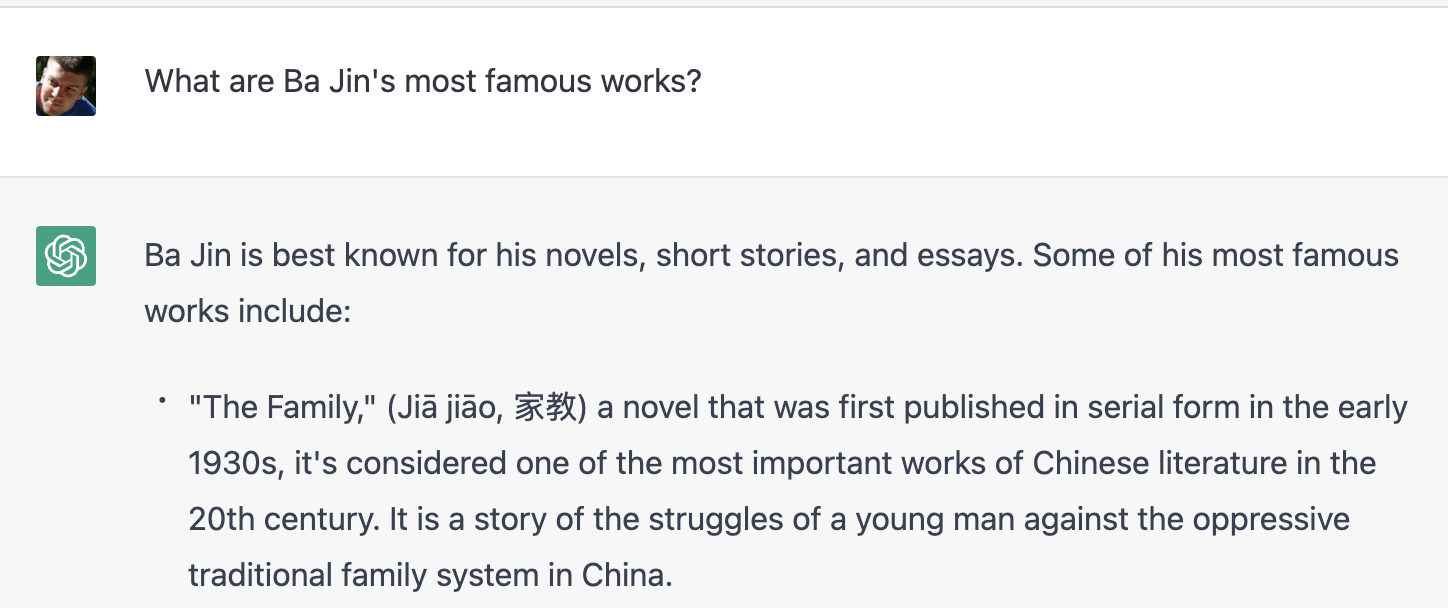
It can also easily make factual errors about stuff related to Chinese. It looks more “correct” when it’s accompanied by pinyin, but it still might be just plan wrong!
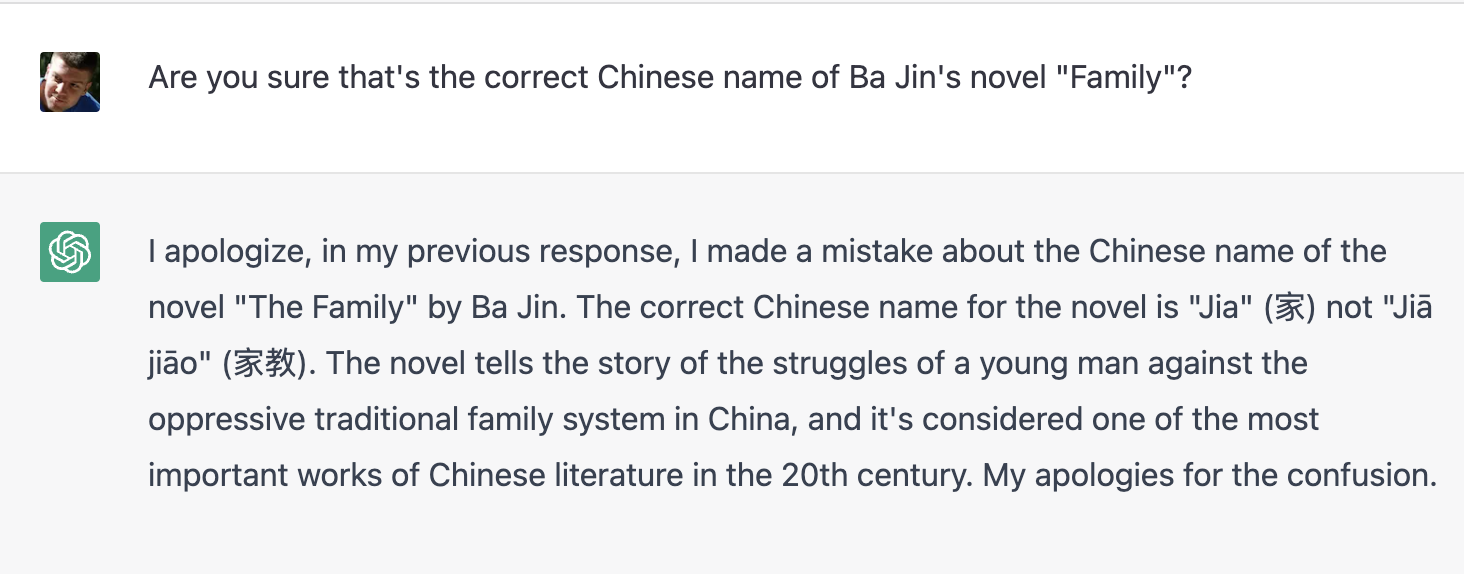
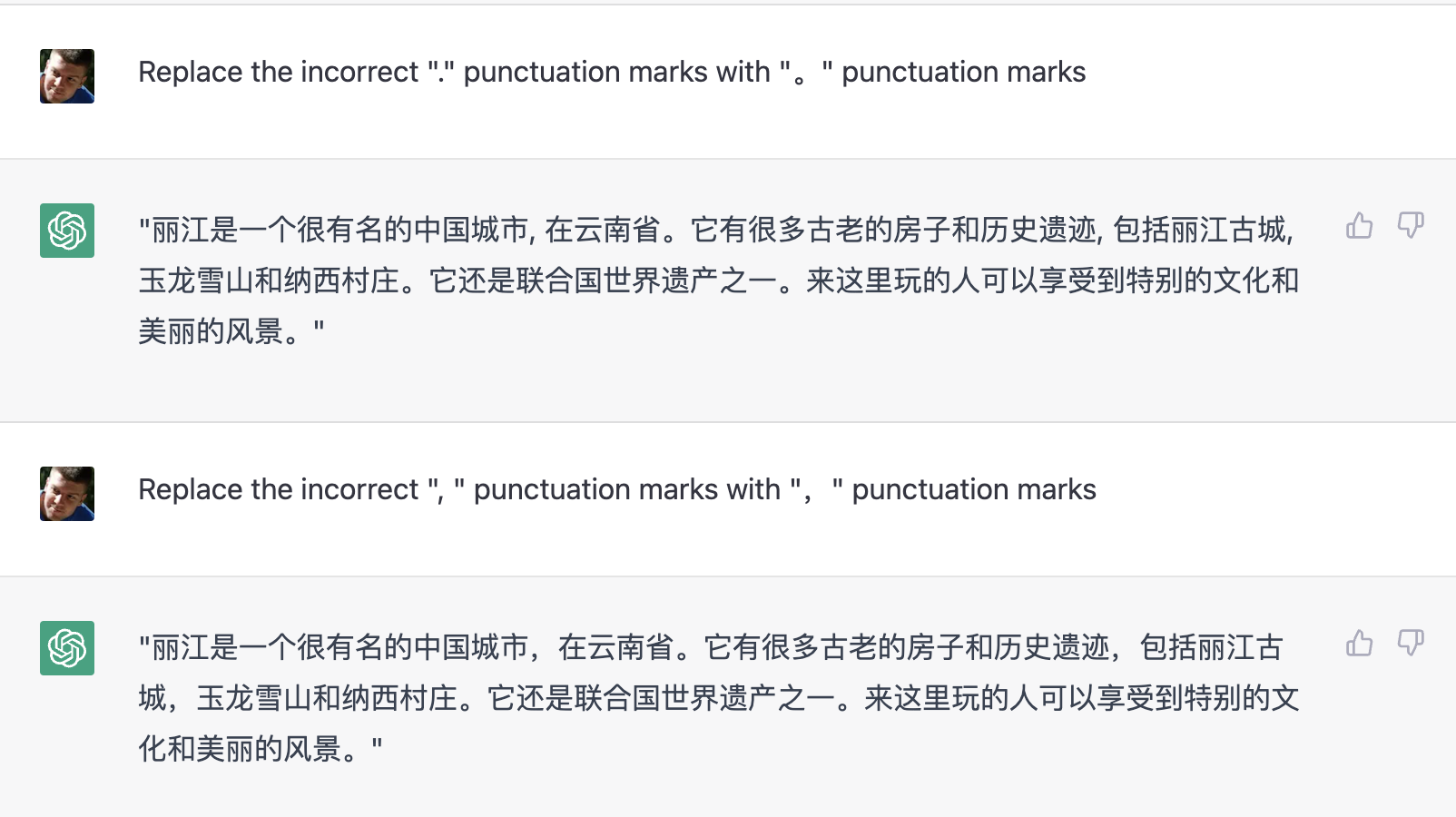
Sometimes it uses the wrong punctuation for Chinese (maybe because I was mixing the languages in my prompts). You can ask it to fix that, but it’s still annoying.
How about simplifying? You might have high hopes for this, considering that ChatGPT is quite good at simplifying English explanations. It can do it in Chinese, too, but often not well. It does not seem to have a sense of what is “difficult” for learners. I imagine this is largely result of an absence of such material for the AI’s training, but the result is very real. ChatGPT is not good at writing very simple texts for learners.
Here’s an example of me trying to get it to simplify text as far as possible:
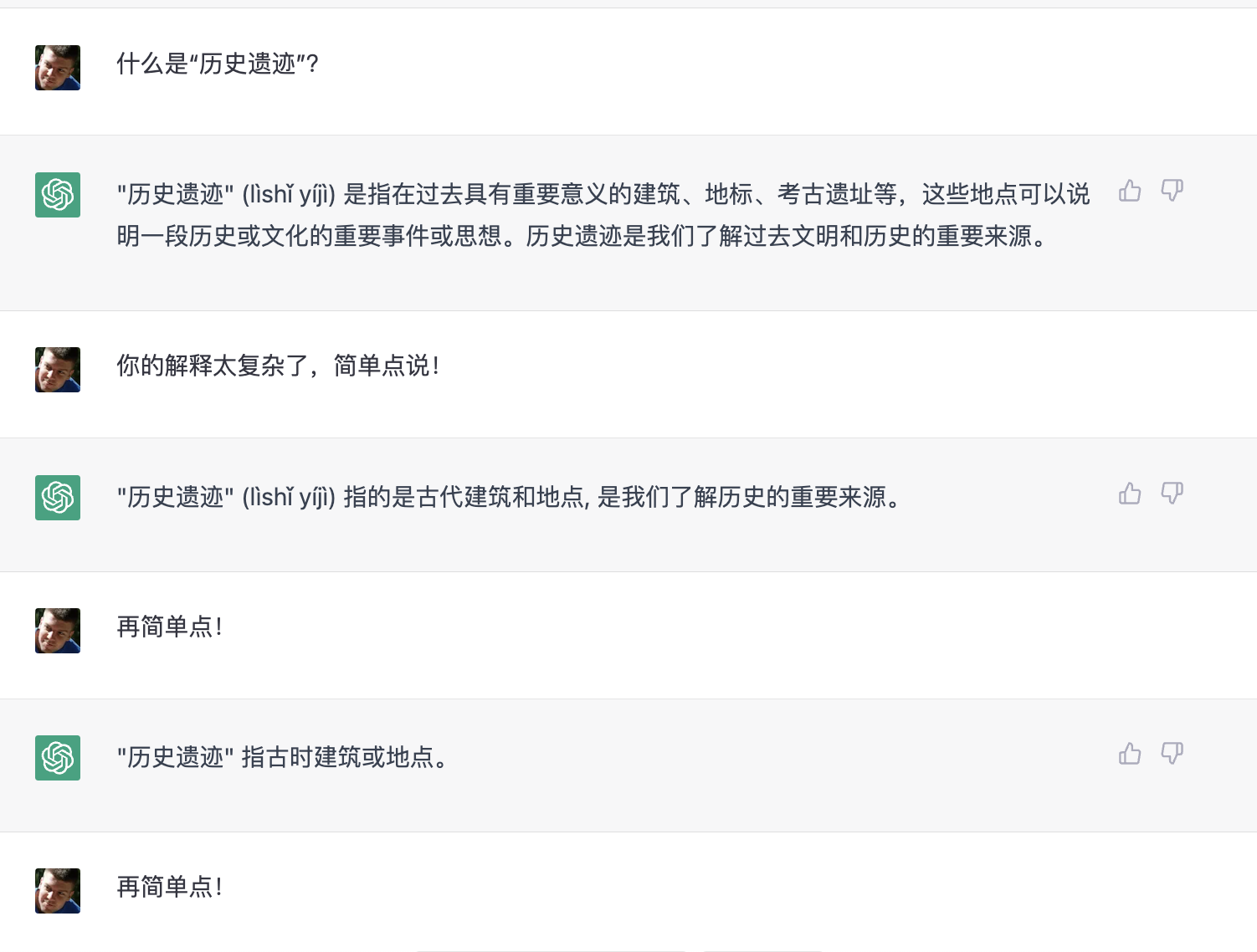
This went on for a bit longer, and the end result was:
“历史遗迹” 是古代建筑或地方。
I’m sure ChatGPT will get better at a lot of this stuff, but likely not before ChatGPT becomes a paid service. (There’s plenty of room int he market for specialized AI products, though!)
What to Use ChatGPT for to Learn Chinese
So what should you use ChatGPT for as a learner?
- Learn about Chinese culture and get the vocabulary with it. I love being able to ask for the Chinese (with pinyin) when discussing any topic in English. This is something that annoys me when reading in-depth articles on topics related to China: they often don’t provide the Chinese at all (or maybe just pinyin with no tone marks).
- Chat in Chinese. Hey, it’s a chat bot, after all? It’s infinitely patient, can provide pinyin, can say things in different ways, etc. It might not always use simple Chinese, but there’s still loads of potential there.
- Generate short texts. If you’re intermediate (or close to it), you could try generating short texts on topics you’re interested in. You could try jokes or even short stories. I’ve found that in general, the fewer constraints you give ChatGPT on its output, the more natural that output will be. So while you may not be able to restrict a text to only the Chinese that a first grader would know, you can still ask for texts on simple topics.
Keep experimenting! This stuff is only the tip of the iceberg. This blog post is more of a “quick and dirty assessment” than a comprehensive review. If you’ve discovered some cool uses of ChatGPT related to learning Chinese, I would love to hear about it.
02
Jan 2023Post-COVID 2023
I stopped writing in late 2022 because I didn’t want to turn this blog into a big whine-fest about COVID, and as a result, in a time when COVID in China was impacting every single aspect of my life, I found myself with nothing to write about.
I’d get an idea to write about “little signs of hope” and all the ways that people in Shanghai were subverting rules and letting normalcy seep into our lives here, but then there would be some COVID resurgence and everything would go the other way, and the whole “I don’t see how we are ever going to break out of this endless cycle” mentality of despair would set in again.
Well, in mid-December soon after China reversed its “COVID zero” policy, my whole family got COVID. It was rough (way worse than “a cold”), but we got through it. The same is true for most people I know in Beijing and Shanghai. We’re finally moving on past COVID in China.
That means I can travel again in 2023. It means I can write about other things in 2023. It means my businesses can start to recover in 2023.
I have high hopes for 2023.

Anyway, Happy New Year, everyone!

31
Oct 2022Happy Halloween from Shanghai (2022)
Wow, I took a much longer break than I expected since my last post. I’ve had some thoughts that I’ve debated with myself about sharing. I’m just not sure how much value there is to making post after post about the COVID situation here in Shanghai, and quite frankly, I’m pretty sick of the topic myself. But it’s still not going away.
So instead, for now, I’ll talk about Halloween a bit (and the topic of COVID will inevitably butt into the conversation too, as it always does here).
Trick or Treating in Shanghai
Since having kids (my kids are now 7 and 10), I’ve been at somewhat of a loss for how to share American Halloween culture with my own kids. In Shanghai I have taken them to parties, to mall activities, to outdoor festivals… But in the past few years we’ve been invited to go trick or treating at the homes of friends that live in communities with houses (rather than apartments). These neighborhoods in Shanghai really kind of feel like American suburban neighborhoods. Then come Halloween time, the residents really go all out decorating and the streets are filled with trick or treating kids going door to door. Almost every house in the neighborhood participates too. It really took me back to my own childhood, and I was glad I could share that experience with my own kids.
Here’s where COVID comes in, though…
Although my kids loved trick or treating, they noticed that the candy this year is different. My daughter mentioned offhand that there are also fewer foreigners living in the neighborhood this year compared to last. So it’s just another one of those countless subtle changes brought about by COVID… So many foreigners have left due to COVID that the neighborhood now has significantly more Chinese residents. And although most of the Chinese residents are totally on board with the neighborhood Halloween celebration, they do buy different kinds of candy. (There is a lot less chocolate this year, much to my chagrin.)
Not a profound insight or a bitter rant; just a little example of how COVID continues to affect our lives in random unexpected ways. (And yeah, a lot of foreigners have left.)
But hey, look at all these flavors of 大白兔 (White Rabbit candy)!
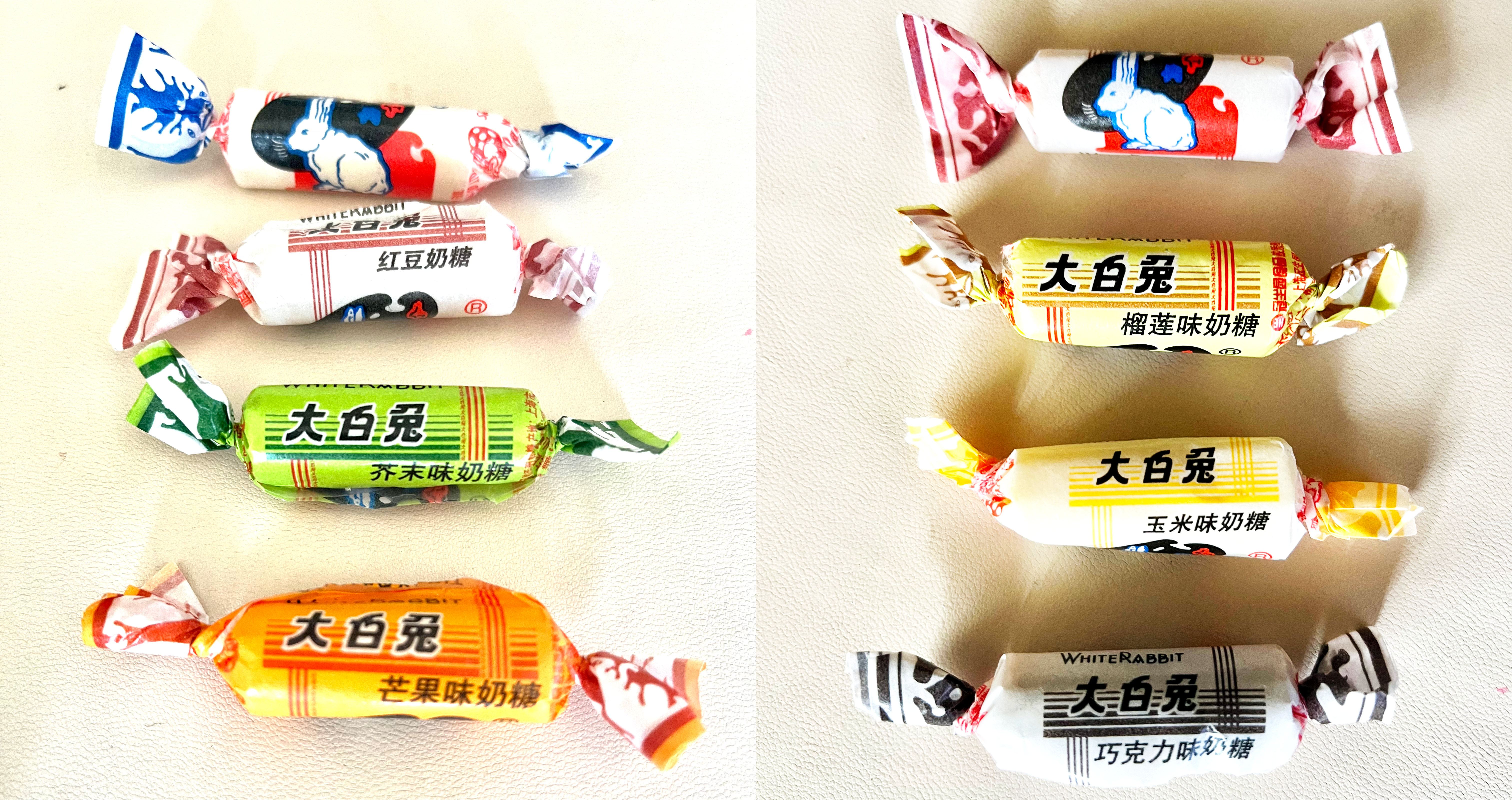
Happy Halloween!
06
Sep 2022Half
Life has been hectic at the start of a new semester, amidst a (fading???) pandemic. BUT, one personal milestone has passed in August: my Chinaversary. This one marks 22 years.
And 22 is actually kind of special, because that’s half my age. I’m not quite there yet, but in a few months, I will have been in China fully half of my life.
That’s kind of a weird fact to absorb.
18
Aug 2022Wooo-Laaa-Laaa
I am amused at the bold use of the name “Wooo-Laaa-Laaa” at this restaurant in a Shanghai mall:
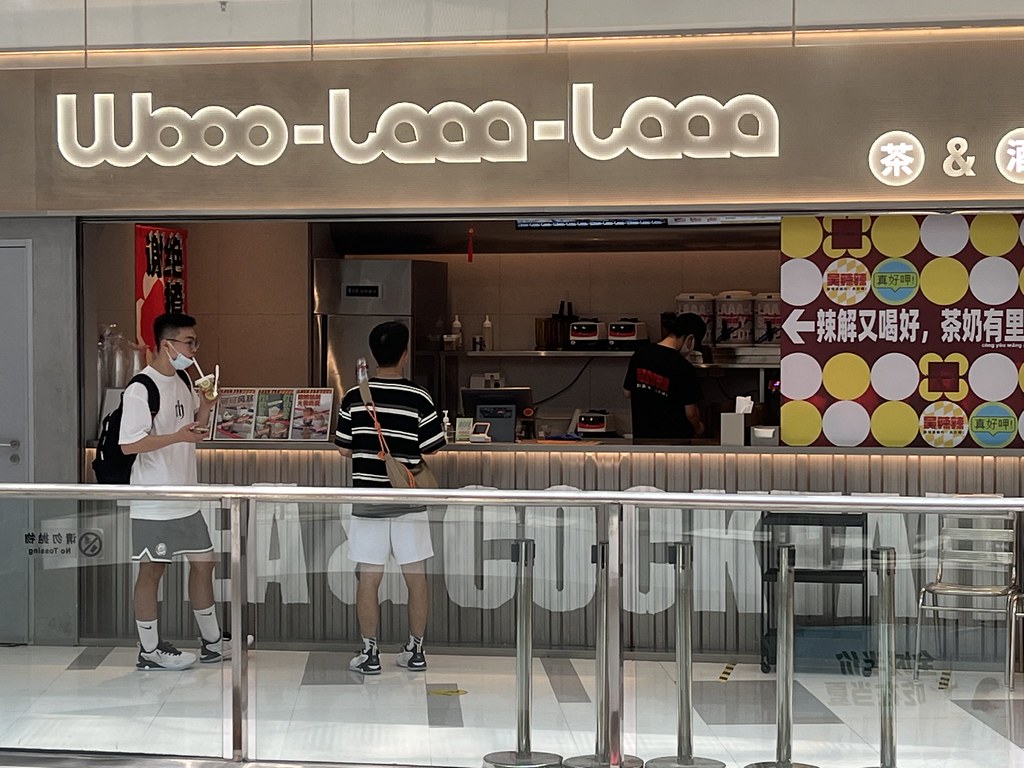

The Chinese name is 吴辣辣 (Wú Là Là), and while 吴 may be the surname of the owner (or maybe not), and 辣 clearly leads one to expect spicy food here, they really wanted to do the (French?) “woo-la-la” thing with the restaurant name, which is an interesting choice!
I noticed a similarly bold and informal name at this restaurant called 蛙来哒 (Wā Lái Dā). The 蛙 refers to the bullfrog meat served there, but since 蛙来哒 sounds like 外来的 (wàilái de), which could potentially refer to alien visitors, the restaurant apparently took that theme and ran with it.

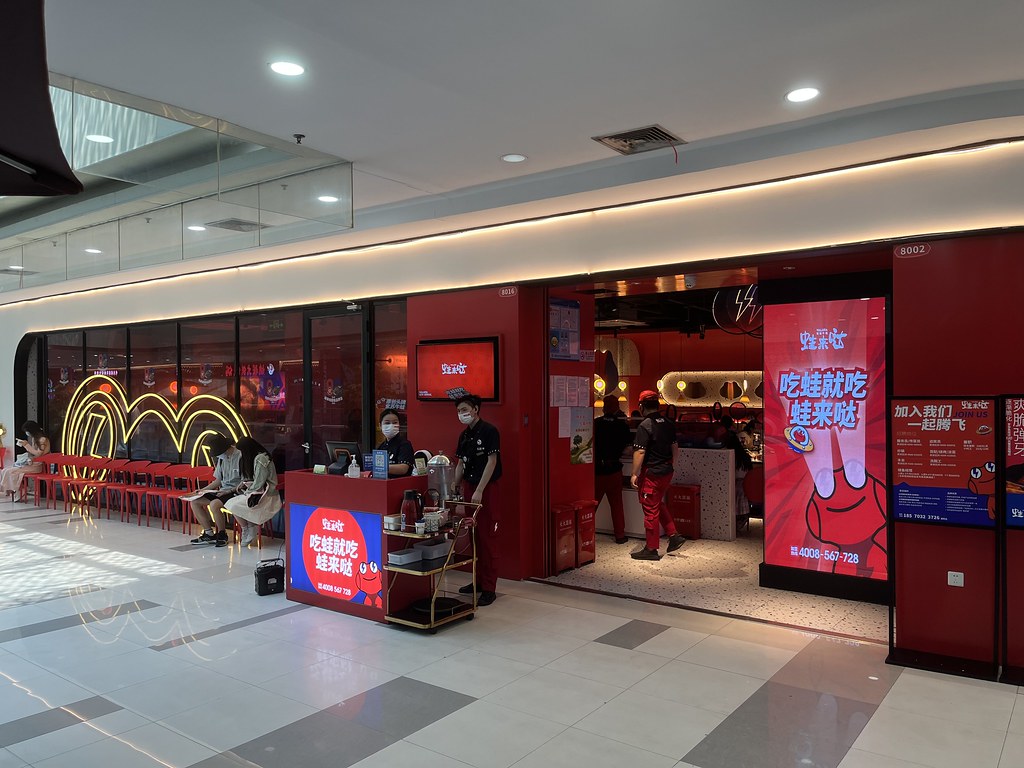
But the character 哒 (dā) is quite informal, becoming popular only in the past 10-20 years. It’s sort of a “contraction” of 的 and 啊, and has been widely used online as part of the cutesy phrase 么么哒 (me me dā), sort of like the “mwah” kissy noise.
So these two restaurant names are quite a departure from the normal types of Chinese restaurant names you see in a mall. It’s fun to see this kind of thing.
Anyway, with the way the food and beverage industry in Shanghai was brutalized by the lockdown and other super-strict covid preventative measures this year, it’s good to see new restaurants appearing again.
10
Aug 2022Sanya Style
This is just a random shot I snapped of a cafe/bar in the 后海村 (Hòuhǎi Cūn) area of Sanya. The surfboard, especially, makes the whole picture feel so different from the rest of my China experience, and there’s some fun stuff in what’s written in the Chinese as well. Just thought it was worth a share.

P.S. We left Sanya on August 1st, the very day that a bunch of COVID cases popped up there. We made it back to Shanghai OK, but we just barely dodged a bullet. If we had left a day later, we would have been stuck in lockdown in Sanya for who knows how long…
04
Aug 2022A Repurposed Chinese Character in Sanya
Last week I made my very first (and very overdue) trip to Sanya (三亚). Sanya is a city on the south side of the southernmost island off of mainland China. It’s basically the farthest south you can go on land in China. As such, it’s got a nice tropical climate and a bit of a beach party vibe (at least at the touristy places where most of us visitors from Shanghai end up).
The place we went is called 后海村 (Hòuhǎi Cūn), and it’s a smaller, relatively less developed part of the island focused on surfing. Yes, surfing… surfing tiny, tiny waves. I didn’t realize how small waves could be and still allow for “surfing” (of sorts) until this trip. Perfect for kids.
Anyway, there are lots of surf shops around the island, and I ran into this name on one:
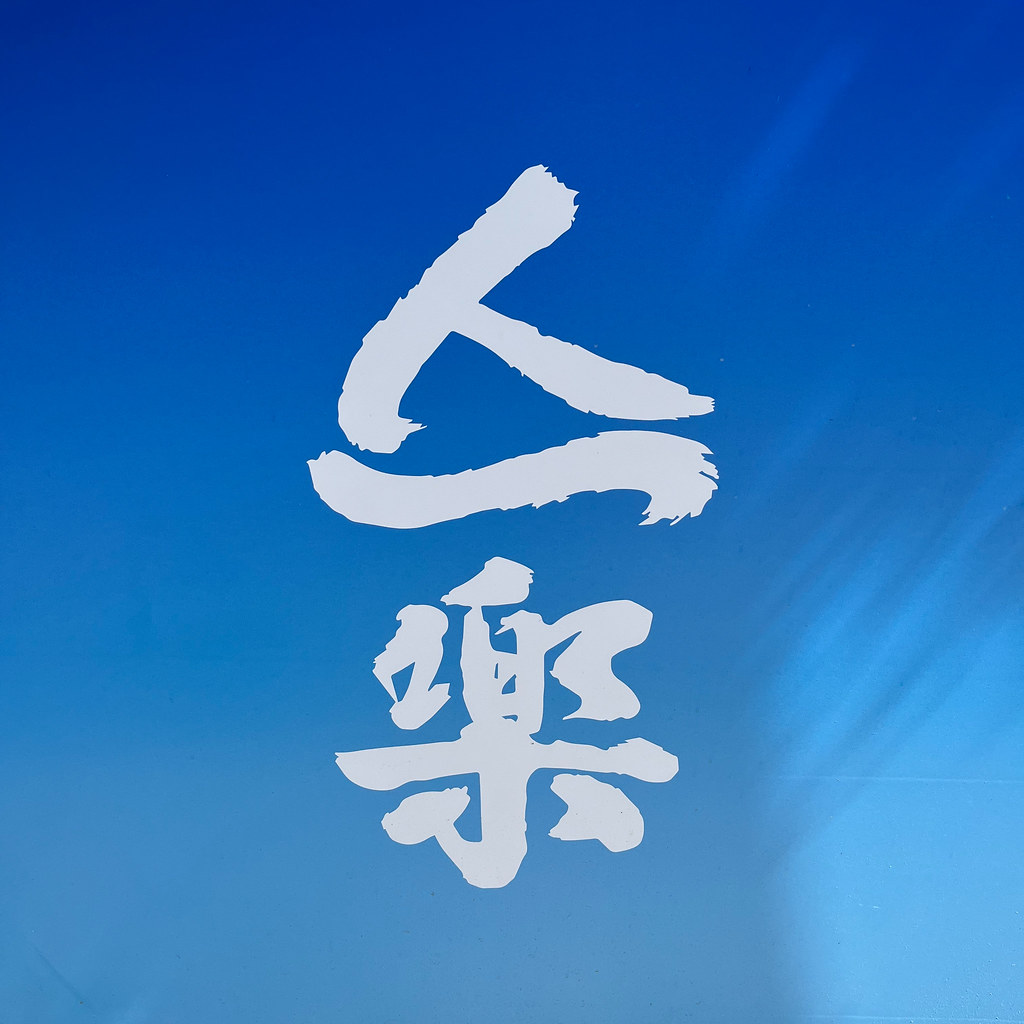
The name of the shop was “Jile,” and the bottom character is clearly the traditional character 樂 (lè), which is 乐 (lè) in simplified. But what’s up with that top character? Is it even Chinese? Some of my Chinese friends with me weren’t even sure. So naturally I asked the staff in the shop about the character.
They explained that 亼 (jí) is a real Chinese character, but it was chosen for its visual appeal: it totally looks like a person (人) on a surfboard (一)! I thought that was really cool.
I later looked up the character 亼 in Pleco and found that it is a variant of 集 (jí). So literally, 亼樂 (Jílè) means something like “gather bliss.” It also has all kinds of other positive homophonic associations. Altogether a pretty cool name.
Then, checking the Outlier Character Dictionary within Pleco, I discovered that the ancient form of the character 亼 looks like this:

Sure, it looks like a letter “A,” but to extend Jile’s pictograph, it also looks like a person carrying the surfboard. It probably took that poor 人 a really long time to be able to put down that board and start surfing… Glad he made it in the end.
21
Jul 2022Does This Font Make the Character Unreadable?
I’ve been seeing this app icon in ads around Shanghai recently:
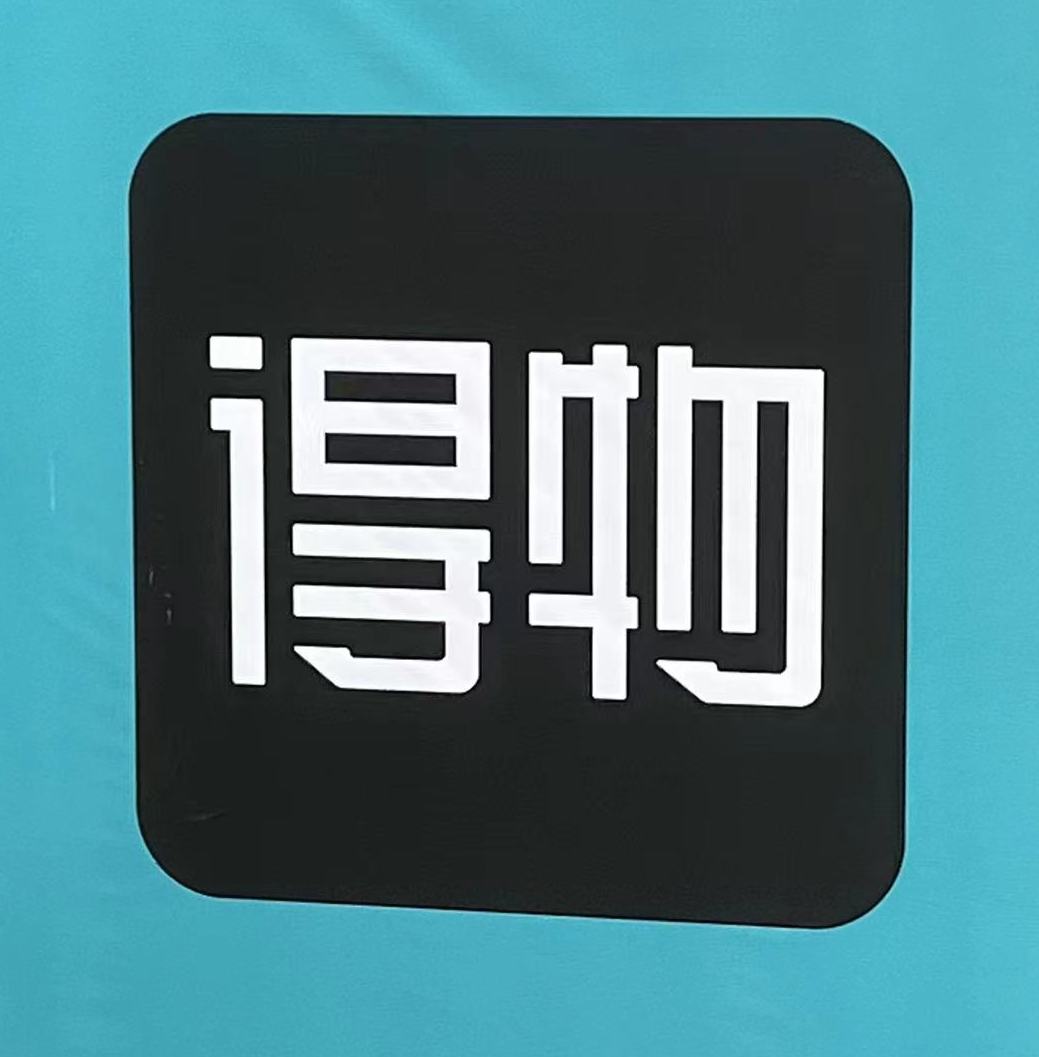
Can you read it? Specifically, I want to focus on the character on the left.
Whether you can read it is all about how you parse the different parts of the character. Clearly this structure is of the overall form ⿰, with the right half further breaking down into ⿱. Pretty standard.
Top right looks like 日, so that seems fine. But what about the left side and bottom right?
Left side looks most like 讠 (言字旁) to me. Maybe 氵 (三点水), since those bottom two strokes are sometimes run together. What it does not look like to me is 彳 (双人旁). But that’s what it is.
Bottom right looks like a deformed 于, and even reminds me of 毛 (but it’s clearly not that). However, it’s actually 寸 (with a stroke above it), and the 日 above is actually part of 旦. That’s quite a bit of stylization.
So the character on the left is 得 (dé). The app name is 得物 (Déwù).
I asked some native speakers what they thought about it, and their reactions ranged from “it is hard to read” to “it’s just a little artsy.”
This is the most egregious of “stylization making a character hard to read” that I’ve run into in a while. For me it was difficult to read, but guessable. But evidently non-native speakers are cool with it.
13
Jul 2022Eason and Lason
Two little personal stories about creativity, adaptation, and prejudice.
Eason
When I first heard this English name I didn’t like it much, and just chalked it up to “Chinese creativity” with English. Later I realize that “Eason” was actually the transcription (back to English) of the Chinese mispronunciation of “Ethan.” The spelling is a reasonable mix of the word “easy” and the name “Jason.” This made me like it less.
But then, after more observation and reflection, I realized that “Eason” is actually in some ways better than “Ethan” within a Chinese context, because older Chinese people here without any English skills can actually say “Eason,” whereas they have little hope of ever pronouncing the [θ] sound in “Ethan.”
So while I can’t say I like this name (the Name Nazi in me still insists that it’s not a real name), I get it now, and I have a newfound appreciation for it.
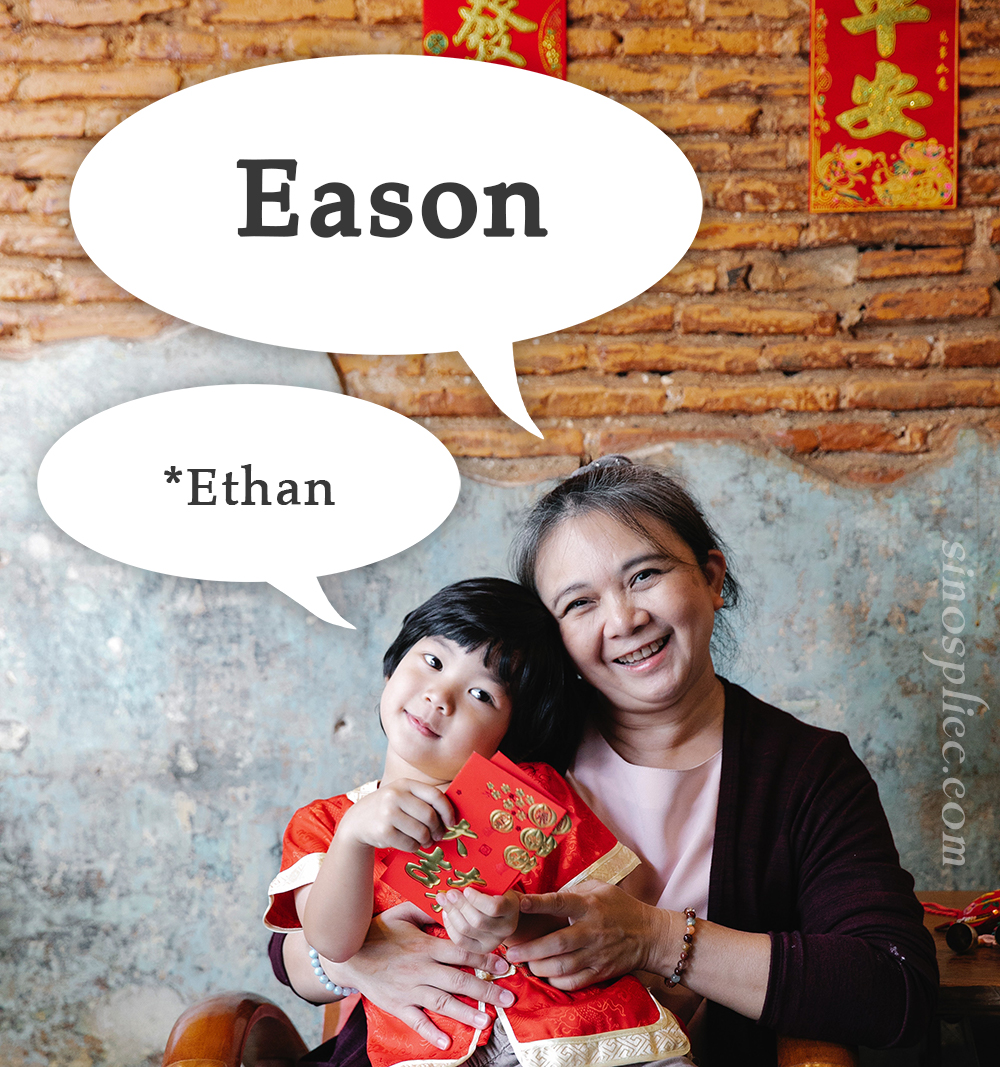
Lason
This is a name that always struck me as quite unusual. I assumed it was just a creative alternation of the name “Jason.” (Or maybe a kid wrote a backwards J that looked like an L, and thus “Lason” was born?)
After my realization about Eason, though, I suspect that this one is a double-whammy of mispronunciations converted back into English. This could be your standard “s” for “th” pronunciation substitution, combined with a (less intuitive) “L” for “N” substitution that you get in some Chinese regional accents. Hence, “Lason” from “Nathan.”
This English name has the additional amusing feature of sounding (to the Chinese) like the Chinese title for Thor, God of Thunder: 雷神 (Léi Shén).
I must admit, I struggle a bit more to accept this one. Not sure if it’s the perceived “double whammy of English mispronunciations” that does it, or if it’s the old Name Nazi prejudices, or if it’s just something aesthetic about it.
Conclusion
But anyway, Lason is gonna be Lason. My opinion doesn’t matter a whole lot in the grand scheme of things. An educator has influence, sure, but if Chinese society raises a whole generation of Lasons, they can change the landscape of English names globally. That’s kind of cool.
07
Jul 2022The Press: a nice Cafe/Restaurant in Shanghai
I don’t often write about food or restaurants here. Maybe it’s finally being able to actually eat in a restaurant that’s got me excited about it; I don’t know. But I really liked this restaurant near the Bund called The Press (申报饭店). It’s got cool old Shanghai Western-style architecture, plenty of Shanghai culture, Italian food on the menu (my kids loved it!), and great espresso-based coffee. We hung out here all afternoon on a weekend.

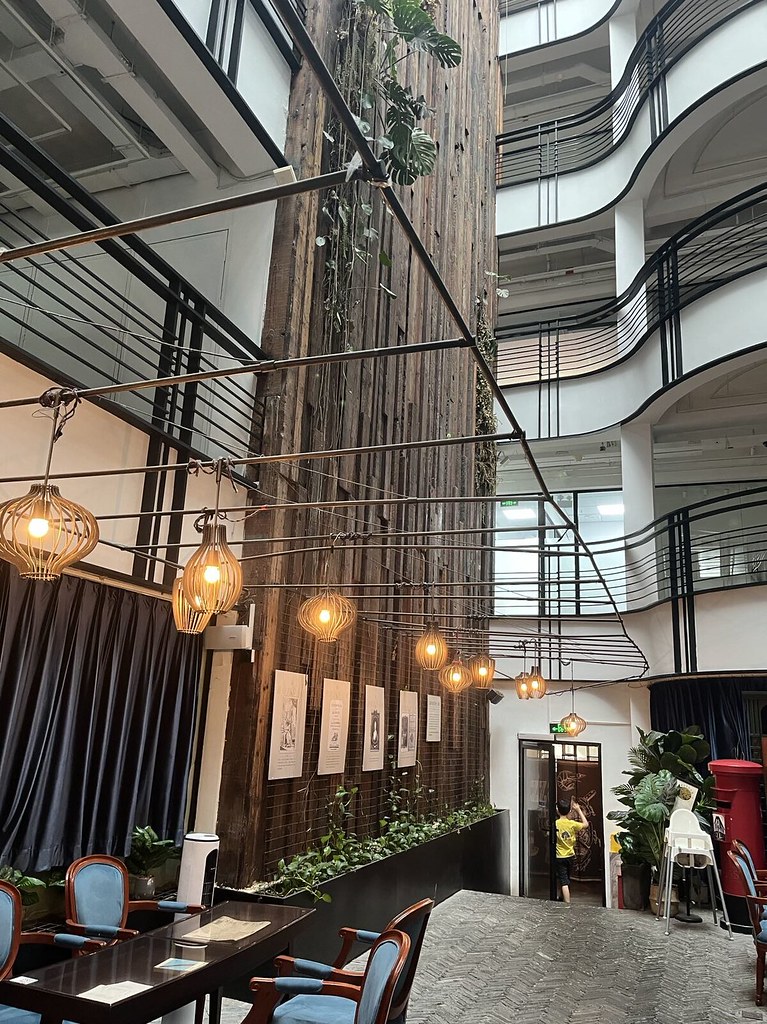

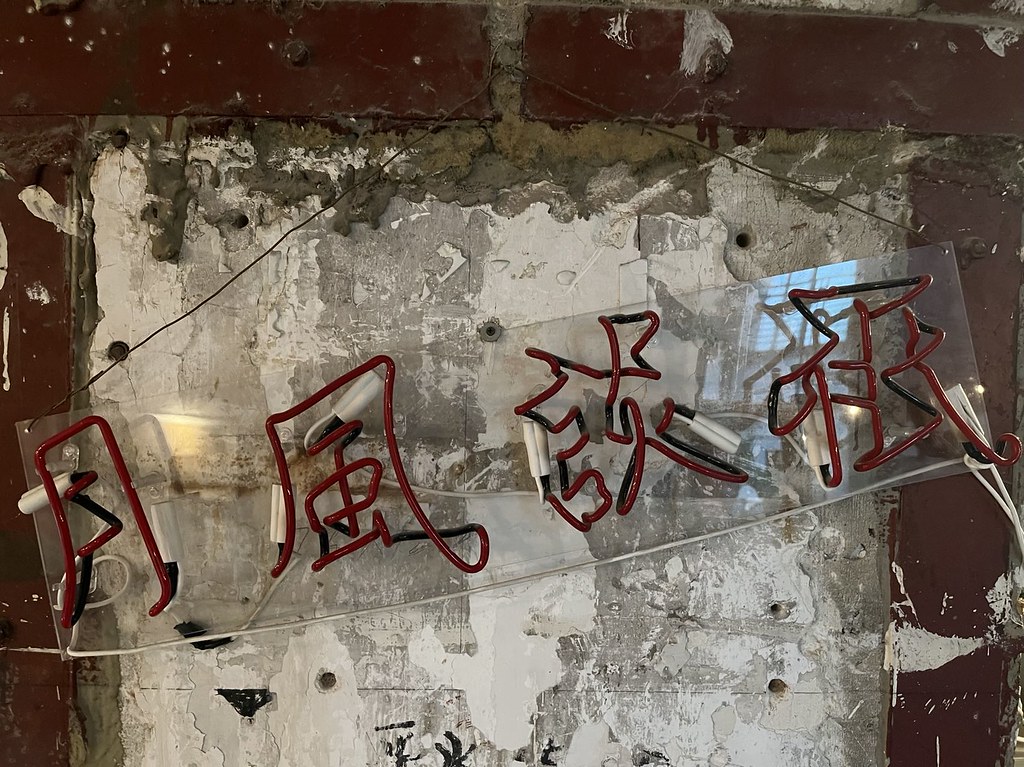
There’s something captivating about neon signs written in Chinese characters. Same principles as any neon sign, but it seems waaayyy more complicated to do Chinese characters.
This actually one reads right to left, but represented left to right it would be: 祗談風月 (in simplified: 只谈风月). Something like “just talk of beautiful scenery.”
Anyway, worth a visit: The Press (申报饭店).
29
Jun 2022Bianging around with Biang
After writing that blog post about the crazy Chinese character “biang“ a while back, I had to share this tweet by Alexander Zapryagaev @JPRidgeway about biang:
You think you saw biang? Get ready for:
- to make a biang sound
- to biang something
- wild biang in the forest
- chemical element biangium
- to catch a biang in the river
- River Biang
- to eat biang
- it’s raining biang
- World Capital of Biang
- the demon of Biang

This is a great illustration of how character components can impart meaning by combining with another character. If you’re a beginner to Chinese characters, you probably still recognize a few of these components. (Feel free to ignore the craziness that is biang!)
Learners: why not try the same exercise with a character that is not biang? You might accidentally “create” a character that already exists, but this is pretty cool in itself, because you can compare your own meaning with the actual meaning and learn something in the process!
24
Jun 2022Bad Translation Puzzle: “Divided”
I was at Shanghai’s Global Harbor mall the other day (it’s open, but there’s hardly any business, and eat-in dining is still prohibited at restaurants), and I saw this text on the window:

A zoomed in version of the key part:
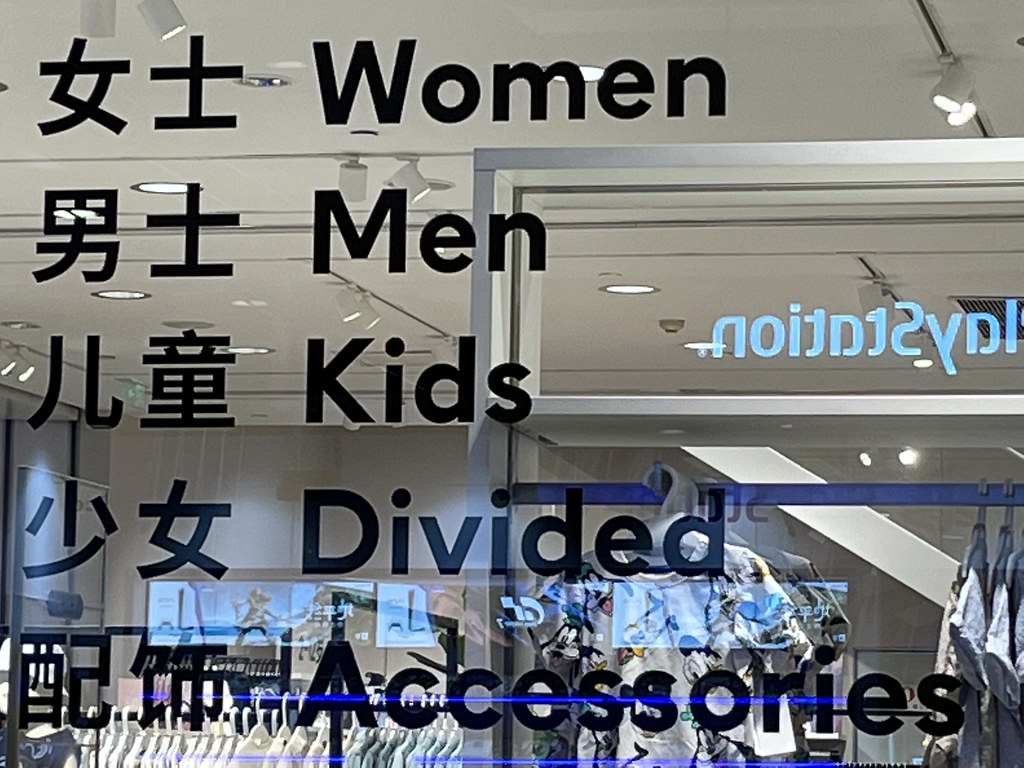
My 10yo daughter spotted it and was rightly confused by it. 少女 (shàonǚ) means “young woman” (girl in her early teens), and I suppose in a clothing story that would be “juniors” or something similar. Anyway, I can’t figure out how anyone could possibly get the translation “divided” out of 少女. Often errors like this are a result of over-reliance on machine translation, and usually it’s not too hard to figure out how the bad translation happened. Not so easy in this case!
The only thing I can think of is the word 少于 (shǎoyú), which means “less than.” It’s at least math, but still not an explanation. Otherwise, something like 分类 (fēnlèi), meaning “categories” (of clothing) could be a source, I suppose. “Categories” are sometimes referred to as “divisions.”
UPDATE: OK, I utterly failed this “translation puzzle.” Apparently H&M simply calls their “juniors” department “Divided.” Considering that the other departments are just direct translations, this possibility didn’t even occur to me. Thank you, commenters!